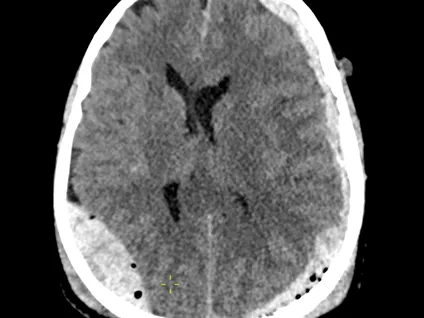
Traumatic brain injury is one of the most common causes of urgent imaging in busy emergency departments, therefore every radiologist must have confidence in reading trauma head CT studies.
This reporting module intends to promote a structural approach to reading traumatic brain studies, which makes it easier, and significantly increases sensitivity for more subtle injuries in otherwise near-normal studies.
The module will interactively demonstrate the common patterns of traumatic intracranial haemorrhages and the key points helping to differentiate them whenever possible. On the other hand, some cases were specifically selected to show the less common trauma-related findings, which are important to be aware of and not to overlook when reading the studies in your practice.
The training contains 5 anonymised CT cases from the TMC on-call department.
Accreditation and CME certificate
This is a CME-accredited radiology training by TMC Academy, an EACCME Trusted Provider. 2 CME credits will be granted upon completion.
- Structural approach to brain trauma CT study reading
- Identifying and differentiating intracranial injuries and skull fractures
The content will be relevant to anybody who works in the emergency radiology department.
Image Reporting Simulator - How does it work?
The specialised radiologist mentor - Dr Jonas Anuzis has carefully prepared a structured reporting template to help you report the cases, formatted in a quiz format while you also view the cases in a web-based PACS-viewer on the right.
1. First, you should review the case images.
2. Then, you can begin the reporting template quiz (meanwhile still reviewing the images on the right)
3. After you submit your answers, the correct answers will appear and you will receive a score for your report.
4. Alongside the answers, you will also find helpful comments and learnings that the specialised radiologist mentor has left. There might also be arrows or markings on the images to help you see relevant findings.
5. If you score more than 66%, you have passed the module and can download your CME Certificate. If you did not pass, you can reset the module and try again.
You can save the module whenever you want and return to it later, giving you the flexibility to practice on your own time.
If this is your first Image Reporting Simulator module, don't miss:
• introductory video to the right
• our FAQ page
You can also email us directly with your questions.
| Hardware | Tablets * | Minimum | Recommended |
|---|---|---|---|
| Memory (RAM): | 2 Gigabyte | 8 Gigabyte | 16 Gigabyte |
| Processor (CPU): | Dual core 1.85 Ghz | Dual core 2 Ghz | Quad core 2.5 Ghz |
| Internet connection | Minimum | Recommended | |
| Speed: | 10 Mbps | 25 Mbps | |
| Software | Tablets | Desktop | |
| Browser: | Safari * | Chrome ** | |
- * Tested with Safari on iPad 9.7 (2017), should also work on Android with Chrome. User interface not optimized for smaller screens. Large cases (more than 600 images) are not able to be opened on tablet or mobile devices due to memory consTableRowaints.
- ** Firefox, Edge and Safari also work but might not provide an equally smooth experience. Internet Explorer is not supported.