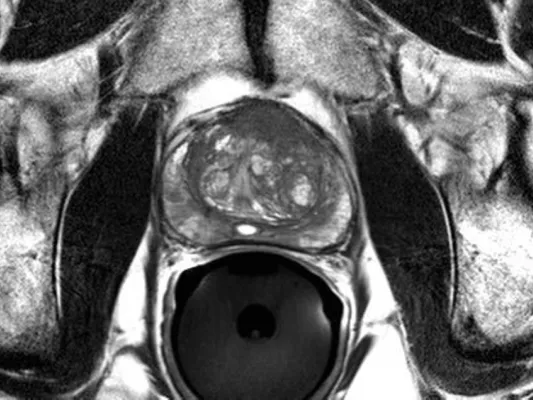
Prostate MRI
Description
This prostate MRI reporting course includes 40 clinical prostate MRI cases for you to report in our Radiology Simulator (an integrated online PACS viewer with structured reporting and immediate feedback, including annotations and hangings).
It offers hands-on practice in reading MRI for prostate cancer detection using the criteria recommended in the recently updated PI-RADS v2.1 (Prostate Imaging Reporting and Data System) guidelines.
It will help you understand the different criteria according to the dominant sequence and the zonal anatomy to provide a final score category whether there is a high or low suspicion of a significant cancer. The module is focused on the most relevant features to analyse on an MRI examination of the prostate to detect prostate cancer.
The course is delivered using a Reporting Simulator — a unique, interactive tool integrated in our e-learning platform designed for radiologists to mirror real-life clinical practice. Unilabs Academy Radiology Simulator includes a DICOM image viewer and a dynamic, structured reporting form. Upon submitting a report, you receive immediate, case-specific feedback, allowing you to identify gaps and refine your reporting skills.
The MRI training contains 40 anonymised real-life cases, grouped into 6 modules, drawn from the mentor's teaching files.
You can start for free and complete the first 5 cases at no cost. Full access to all 40 prostate MRI cases and other reporting courses and webinars can be unlocked by purchasing a Premium Membership.
📅 Join also our Basic Prostate MRI online fellowship with Prof. Kai Vilanova in October 2026!
Live lectures, case reading, and plenty of Q&A in an interactive format.
Check the agenda and schedule here
Learning Objectives
- To be able to recognise the different criteria to detect significant prostate cancer
- To learn the different signs and features to provide the optimal category for the final PI-RADS score
- To understand the different MRI criteria according to the dominant sequence and zonal anatomy of the prostate
Level
Radiology Simulator - How does it work?
The specialised radiologist mentors have carefully prepared a structured reporting template to help you report the MRI cases, formatted in a quiz format while you also view the cases in a web-based PACS-viewer on the right.
1. First, you should review the case images.
2. Then, you can begin the reporting template quiz (meanwhile still reviewing the images on the right)
3. After you submit your answers, the correct answers will appear and you will receive a score for your report.
4. Alongside the answers, you will also find helpful comments and learnings that the specialised radiologist mentor has left. There might also be arrows or markings on the images to help you see relevant findings.
5. If you score more than 66%, you have passed the module and can download your CME Certificate. You can reset the module and try again if you did not pass.
You can save the module whenever you want and return to it later, giving you the flexibility to practice on your own time.
📽 If this is your first Radiology Simulator reporting course, don't miss the introductory video to the right!
Check our FAQ page you can also email us directly with your questions.
Technical Requirements
| Hardware | Tablets * | Minimum | Recommended |
|---|---|---|---|
| Memory (RAM): | 2 Gigabyte | 8 Gigabyte | 16 Gigabyte |
| Processor (CPU): | Dual core 1.85 Ghz | Dual core 2 Ghz | Quad core 2.5 Ghz |
| Internet connection | Minimum | Recommended | |
| Speed: | 10 Mbps | 25 Mbps | |
| Software | Tablets | Desktop | |
| Browser: | Safari * | Chrome ** | |
- * Tested with Safari on iPad 9.7 (2017), should also work on Android with Chrome. User interface not optimized for smaller screens. Large cases (more than 600 images) are not able to be opened on tablet or mobile devices due to memory consTableRowaints.
- ** Firefox, Edge and Safari also work but might not provide an equally smooth experience. Internet Explorer is not supported.
Introduction Video
Lecturers