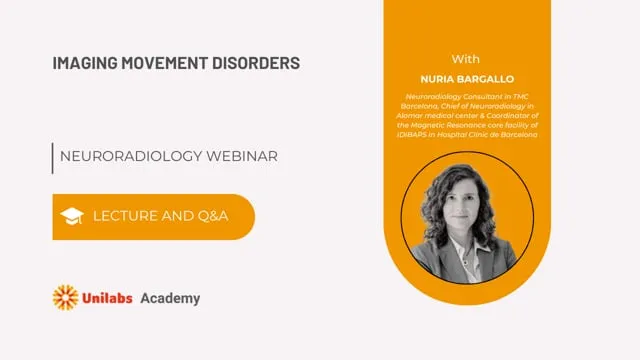
On-demand Webinar
·
0.5 CME Credits
Imaging movement disorders
Structural and functional neuroimaging reveal characteristic patterns in Parkinsonian and hereditary movement disorders.
Already have an account?
Description
Relevant neuroanatomy and imaging techniques introduce idiopathic Parkinson's disease and atypical Parkinsonian syndromes. Characteristic findings in hereditary and metabolic disorders, including Huntington's and Wilson's disease, extend the differential diagnosis.
Learning Objectives
- Relate movement-disorder neuroanatomy to structural and functional imaging techniques.
- Distinguish idiopathic Parkinson's disease from atypical Parkinsonian syndromes.
- Recognise imaging patterns in selected hereditary and metabolic movement disorders.
Topics Covered
To jump to a specific chapter, click on the chapter title once the video is playing.
00:00 - Introduction and Overview of Imaging Movement Disorders
10:17 - Anatomy and Neuroimaging Techniques
18:18 - Functional Neuroimaging and its Importance
29:29 - Idiopathic Parkinson's Disease: Imaging Techniques
36:53 - Atypical Parkinsonian Syndromes and Their Imaging Characteristics
40:53 - Hereditary Movement Disorders: Huntington's and Others
46:56 - Wilson's Disease and Final Remarks
Lecturers

Nuria BargallóM.D. Ph.D.
Barcelona, Spain
Consultant in Neuroradiology, Telemedicine Clinic, Barcelona
Chief of Neuroradiology, Alomar medical center
Coordinator of the Magnetic Resonance core facility of IDIBAPS
Hospital Clinic de Barcelona, Spain
Honorary consultant in National Hospital of Neurology and Neurosurgery, London
Senior Consultant in Neuroradiology of the Hospital Clínic de Barcelona focused on advanced image techniques applied to neurological diseases, mainly epilepsy, inflammatory and neurodegenerative diseases. Dr Bargallo has published more than 230 indexed articles and participated in more than 15 competitive national or international projects the last 10 years. She is currently the coordinator of the Magnetic Resonance core facility of IDIBAPS giving support to the research groups of this institution and the Hospital Clínic in studies involving advanced Magnetic Resonance images.